Have you ever had the same argument with your partner over and over again?
One person feels criticized. The other feels ignored. Someone gets defensive, someone shuts down, and before you know it, you're both feeling more alone than when the conversation started.
This is exactly the kind of pattern that Emotionally Focused Couples Therapy (EFT) is designed to help couples understand and change.
Unlike approaches that focus primarily on communication techniques or conflict-resolution strategies, EFT goes deeper. It explores the emotions, fears, and unmet needs underneath the arguments and helps couples develop a more secure emotional connection.
What Is Emotionally Focused Couples Therapy?
Emotionally Focused Couples Therapy, often called EFT or EFCT, is an evidence-based approach to couples therapy developed by psychologists Dr. Sue Johnson and Dr. Leslie Greenberg in the 1980s, with Johnson subsequently developing the attachment-based model widely practiced today.
EFT is grounded in attachment theory, which suggests that humans have a fundamental need for safe, secure emotional connections with the people closest to them.
We often think about attachment in terms of children and their caregivers. But attachment doesn't disappear when we become adults.
Our romantic relationships can become some of our most important attachment bonds.
We want to know:
Can I count on you when things get difficult?
Do I matter to you?
Will you be there when I need you?
Can I be vulnerable with you without being rejected?
Are we really in this together?
When we feel secure in our relationships, we're generally better able to navigate disagreements, tolerate differences, and support one another.
But when that emotional security feels threatened, our nervous systems can respond in powerful ways.
We may become anxious, angry, critical, defensive, or withdrawn.
EFT helps couples understand these reactions, not simply as bad communication habits, but sometimes as attempts to protect themselves from emotional pain or disconnection.
The Problem Isn't Always the Argument. It's the Cycle.
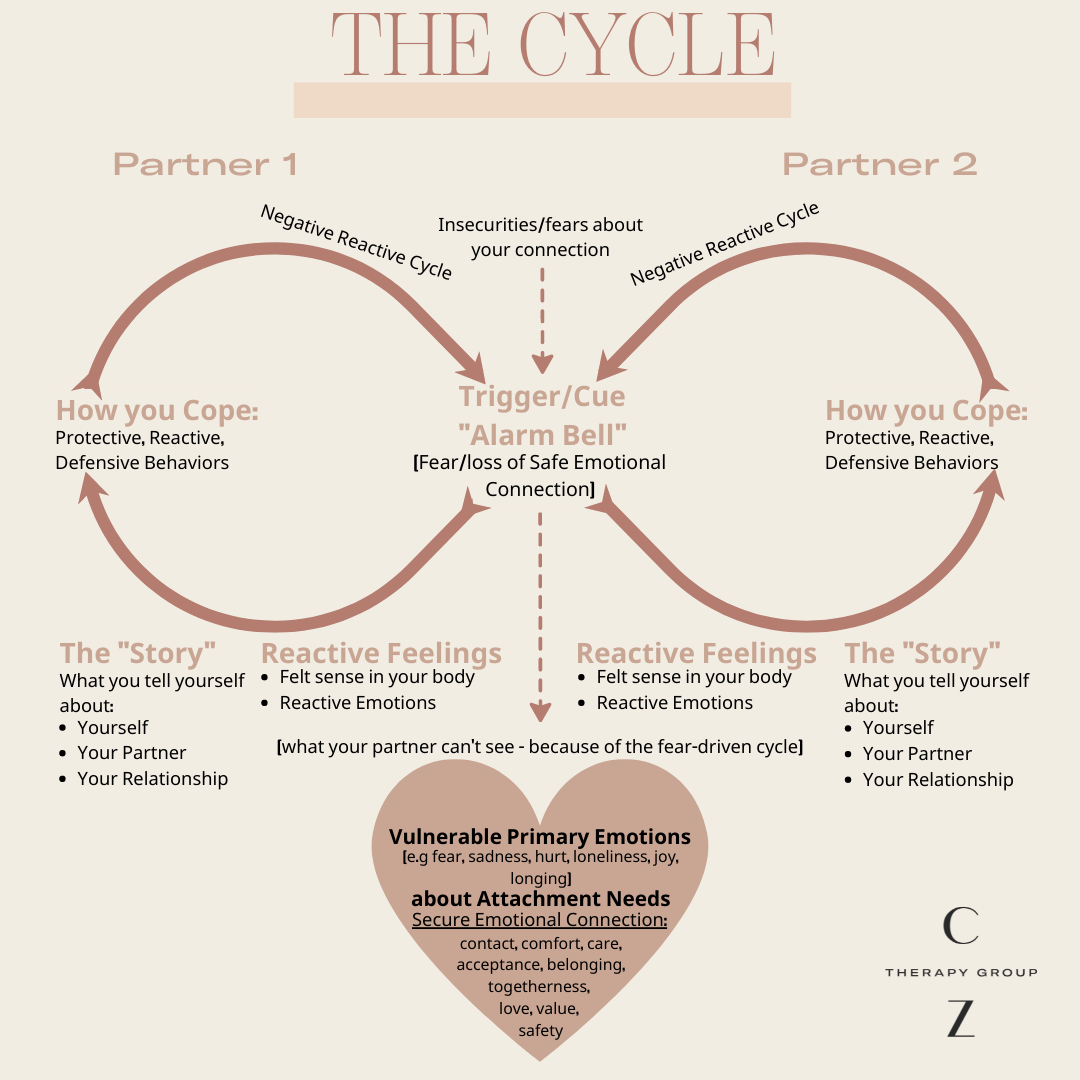
One of the central ideas in EFT is that couples often become trapped in a recurring negative interaction cycle.
Here's an example.
Imagine a couple, Sarah and Michael.
Sarah has been feeling disconnected from Michael lately. She wants more affection, attention, and quality time together.
But instead of saying, "I've been missing you, and I'm afraid we're growing apart," she says:
"You're always on your phone. You never make time for me anymore."
Michael hears criticism.
He feels like nothing he does is ever good enough, so he becomes defensive.
"I work all day. Can't I have a little time to myself?"
Sarah feels dismissed. She pushes harder.
Michael feels overwhelmed and withdraws.
Sarah experiences his withdrawal as confirmation that he doesn't care.
Michael experiences her criticism as confirmation that he can't make her happy.
And around they go.
The more Sarah pursues, the more Michael withdraws. The more Michael withdraws, the more Sarah pursues.
Neither partner is necessarily trying to hurt the other.
In fact, both may be desperately trying to protect something important.
Sarah wants reassurance that she matters.
Michael wants to feel accepted and valued.
But their protective reactions keep creating the very disconnection they're afraid of.
In EFT, the cycle becomes the shared problem, not either partner.
Instead of asking, "Who's causing this?" the therapist helps the couple explore, "What happens between you that keeps pulling you apart?"
What Are Primary and Secondary Emotions?
Another central concept in EFT is the distinction between primary and secondary emotions.
Secondary emotions are often the reactions that show up on the surface.
These might include anger, irritation, frustration, or defensiveness.
Primary emotions are the more vulnerable experiences underneath those reactions.
These might include fear, sadness, loneliness, shame, hurt, or longing.
For example:
What your partner sees (What might be underneath)
Anger about not spending time together (Fear of no longer being important)
Defensiveness during arguments (Shame about feeling inadequate)
Withdrawal or silence (Fear of making things worse)
Repeated requests for reassurance (Fear of abandonment or rejection)
Criticism about household responsibilities (Feeling alone and unsupported)
These aren't universal explanations. Anger can also be a primary emotion, and not every conflict is rooted in attachment fears.
But often, the emotions we express most loudly aren't the ones we most need our partners to understand.
EFT helps people slow down enough to recognize and communicate these deeper experiences.
Instead of saying, "You never care about me," someone might begin to say:
"When I reach for you and you pull away, I feel really alone. I start worrying that I'm not important to you anymore."
That's a very different conversation.
And it creates a different opportunity for the partner to respond.
What Happens During an EFT Couples Therapy Session?
If you're considering EFT, you might wonder what actually happens in the therapy room.
EFT isn't simply sitting on a couch and talking about your feelings for an hour.
It's a structured, experiential approach in which the therapist actively helps both partners understand their emotional experiences and interactions.
1. Understanding your relationship patterns
Early sessions often focus on understanding what brings you to therapy, your relationship history, and the patterns that tend to create conflict.
The therapist may ask questions such as:
What typically happens when you disagree?
Who tends to pursue conversations, and who tends to withdraw?
What do you feel when your partner becomes upset?
What happens inside you when you feel disconnected?
What do you wish your partner understood about your experience?
The goal isn't to decide who's right.
It's to understand how the relationship gets stuck.
2. Slowing down emotional reactions
During a session, your therapist might notice that one partner becomes defensive when the other expresses frustration.
Rather than moving immediately into problem-solving, the therapist may pause the conversation.
They might ask:
"When your partner says that, what happens inside you?"
Or:
"I notice you became quiet just now. Can we slow down and understand what happened?"
This can feel unfamiliar at first, particularly for people who are used to explaining, defending, or intellectualizing their emotions.
But slowing down helps couples become more aware of the emotional experiences driving their reactions.
3. Helping partners share vulnerability
As therapy progresses, the therapist helps partners express deeper emotions and attachment needs in ways that are easier for the other person to hear.
For example, someone who usually withdraws might discover that beneath their silence is a fear of disappointing their partner.
Someone who usually criticizes might discover that beneath their anger is a longing to feel chosen and loved.
The therapist may invite one partner to share that experience directly with the other.
This is where EFT can become particularly powerful.
Instead of simply discussing their relationship, couples begin having new emotional experiences with each other in the therapy room.
4. Creating new ways of connecting
Over time, couples practice responding to each other differently.
The partner who withdraws may learn to stay emotionally present during difficult conversations.
The partner who pursues may learn to express their fears and needs without escalating into criticism.
Both partners develop a greater capacity to recognize the cycle and interrupt it.
The goal isn't to eliminate conflict.
It's to help couples feel safer, more understood, and more connected even when they disagree.
What Are the Three Stages of EFT?
EFT traditionally follows three stages.
Stage 1: De-escalation. The therapist helps the couple identify their negative interaction cycle, understand the emotions driving it, and begin seeing the cycle as a shared problem.
Stage 2: Restructuring the bond. Partners begin sharing deeper emotions and attachment needs, responding to each other with greater accessibility and emotional responsiveness.
Stage 3: Consolidation. The couple strengthens their new patterns of connection and develops healthier ways to navigate future challenges.
These stages aren't necessarily linear. Couples may move back and forth between them as new challenges arise.
Does Emotionally Focused Couples Therapy Actually Work?
EFT has a substantial body of research supporting its effectiveness for relationship distress.
A 2024 meta-analysis examining 20 studies involving 332 couples found meaningful improvements in relationship functioning following EFT, with evidence that gains could be maintained over time.
Earlier research has also found improvements in relationship satisfaction among couples receiving EFT.
However, no therapy works for everyone, and research outcomes depend on factors such as the couples studied, the measures used, therapist training, and the severity of relationship difficulties.
EFT is a promising, research-supported approach, but it isn't a guarantee that every relationship will improve or that every couple will stay together.
What Relationship Problems Can EFT Help With?
Emotionally Focused Couples Therapy may be helpful for couples experiencing:
Repeated arguments that never seem to get resolved
Emotional distance or a loss of intimacy
A pursuer-withdrawer relationship dynamic
Difficulty expressing vulnerability
Resentment and feelings of rejection
Trust difficulties or recovery after betrayal
Stress related to parenting, work, or major life transitions
Anxiety about the stability of the relationship
Feeling more like roommates than romantic partners
EFT can also be valuable for couples who aren't constantly fighting but feel emotionally disconnected.
Sometimes the biggest relationship problem isn't conflict.
It's the gradual disappearance of emotional closeness.
One important qualification: When coercive control, intimidation, or ongoing abuse is present, standard conjoint couples therapy may be inappropriate. A therapist should assess safety before deciding whether EFT is suitable.
How Is EFT Different From the Gottman Method?
Both EFT and the Gottman Method are established approaches to couples therapy, but they emphasize different aspects of relationship change.
EFT
Focuses on attachment and emotional security
Explores vulnerable emotions beneath reactions
Works to transform negative emotional cycles
Uses in-session emotional experiences to build connection
Gottman Method
Focuses on relationship patterns, friendship, and conflict management
Teaches practical relationship skills and structured exercises
Helps couples strengthen connection and manage conflict
Uses research-informed assessments and interventions
These approaches aren't mutually exclusive.
Some therapists integrate elements of both, depending on their training and the needs of the couple.
Do You Have to Be Comfortable Talking About Feelings for EFT to Work?
Not necessarily.
In fact, many people enter couples therapy precisely because they struggle to identify or express their emotions.
Maybe you grew up in a family where feelings weren't discussed.
Maybe you learned that being vulnerable was unsafe.
Maybe you simply don't know what you're feeling until hours after an argument.
You don't have to arrive in therapy knowing how to express your deepest emotions.
Part of the work is learning how to recognize them.
A good therapist will help you move at a pace that feels manageable rather than pressuring you to share more than you're ready for.
What If Only One Partner Wants to Work on the Relationship?
This is a common situation.
One partner may be eager to rebuild emotional connection while the other feels skeptical, exhausted, or uncertain about the relationship.
EFT can help couples explore these differences, but it cannot manufacture willingness or commitment.
Sometimes the initial work involves understanding what makes emotional engagement difficult or frightening.
Other times, when one or both partners are uncertain whether they want to continue the relationship, discernment counseling may be a more appropriate starting point.
Therapy doesn't have to begin with both people feeling equally hopeful.
But meaningful relationship change generally requires some willingness from both partners to participate.
How Long Does EFT Couples Therapy Take?
There's no universal timeline.
EFT is often delivered as a relatively brief, structured approach, and some treatment protocols involve approximately 8–20 sessions. More complex situations may require longer.
The length of therapy depends on factors such as the couple's relationship history, the intensity of their negative cycle, trust injuries, emotional safety, and their goals.
Some couples notice meaningful changes within the first several sessions.
For others, rebuilding emotional security takes more time.
The goal isn't simply to stop arguing for a few weeks.
It's to create changes in how partners understand, reach for, and respond to each other.
Is Emotionally Focused Couples Therapy Right for You?
If you and your partner keep getting caught in the same painful arguments, or if you've gradually lost the emotional connection you once shared, EFT may be worth exploring.
One of the most valuable ideas behind this approach is that our relationship struggles often make more sense when we understand the emotions underneath them.
The partner who seems angry may be feeling alone.
The partner who seems distant may be afraid of failing.
The partner who constantly asks for reassurance may be longing to feel secure.
Understanding these experiences doesn't excuse hurtful behavior or eliminate the need for accountability.
But it can create more room for empathy, connection, and meaningful change.
Sometimes the most important shift in couples therapy isn't learning how to argue better. It's learning how to find each other again.
Couples Therapy in Montclair, NJ
If you're looking for couples therapy in Montclair, Nutley, or elsewhere in New Jersey, I offer an integrative approach that explores attachment patterns, emotional experiences, communication, and the relationship dynamics that keep couples feeling stuck.
My goal is to help both partners feel heard while creating space for greater understanding, emotional safety, and connection.
I offer in-person couples therapy in Montclair and Nutley, NJ, as well as virtual sessions throughout New Jersey.
Research and Further Reading
International Centre for Excellence in Emotionally Focused Therapy (ICEEFT). What Is EFT? https://iceeft.com/what-is-eft/
Rathgeber, M., et al. (2019). The Efficacy of Emotionally Focused Couples Therapy and Behavioral Couples Therapy: A Meta-Analysis. https://pubmed.ncbi.nlm.nih.gov/29781200/
Beasley, C. C., & Ager, R. (2019). Emotionally Focused Couples Therapy: A Systematic Review of Its Effectiveness over the Past 19 Years. https://pubmed.ncbi.nlm.nih.gov/30605013/
Spengler, P. M., et al. (2024). A Comprehensive Meta-Analysis on the Efficacy of Emotionally Focused Couple Therapy. https://doi.org/10.1037/cfp0000233